Phone-Free Schools: What the New Government Rules Mean for Your Child
Schools across England are being told to go completely phone-free throughout the entire school day, including break times and lunchtimes. Education Secretary Bridget Phillipson has written to headteachers making clear that phones should not be seen or used at any point while children are at school.
Here's what parents need to know about the new guidance and how it will affect your child.
What's Actually Changing?
The government has significantly strengthened its guidance on mobile phones in schools. While the previous Conservative government issued guidance in February 2024, Phillipson says it "did not deliver the clarity or consistency that schools need."
The New Rules Are Clear:
- Phones should not be used during lessons
- Phones should not be used during break times
- Phones should not be used during lunchtime
- Phones should not be used as calculators
- Phones should not be used for research
- Teachers should not use their phones in front of pupils
This represents a much harder line than before. Previously, some schools allowed phone use during breaks or permitted devices for educational purposes like research. The new guidance explicitly rules this out.
How Will This Be Enforced?
This is where the guidance gets teeth. Ofsted will now inspect schools on how they implement their mobile phone policies.
What Ofsted Will Look For:
Inspectors will assess whether schools have clear policies in place and whether those policies are being followed consistently. Schools that fail to properly implement phone-free environments could see this reflected in their inspection outcomes.
Teacher Restrictions Too:
Staff have also been told not to use their phones for personal reasons in front of pupils. Research by Teacher Tapp found that 86% of primary teachers and 44% of secondary teachers currently use phones during breaks. Only 2% of schools currently ban staff phone use entirely.
Why Is This Happening Now?
The timing connects to broader concerns about children's screen time and social media use. This announcement comes just a week after the government launched a three-month consultation on banning social media for all under-16s in the UK.
The Evidence Behind the Decision:
Tony McCabe, headteacher at St Joseph's High School in Greater Manchester, told the BBC that screen time for children is "incredibly excessive," with some looking at devices for as long as five hours before the school day even begins.
Research consistently links excessive phone use to:
- Reduced attention spans in classrooms
- Increased anxiety and mental health issues
- Cyberbullying during school hours
- Disruption to face-to-face social development
- Sleep problems affecting learning
The government clearly believes that a school day completely free from phones will help address these issues.
What This Means Day-to-Day
Morning Drop-Off:
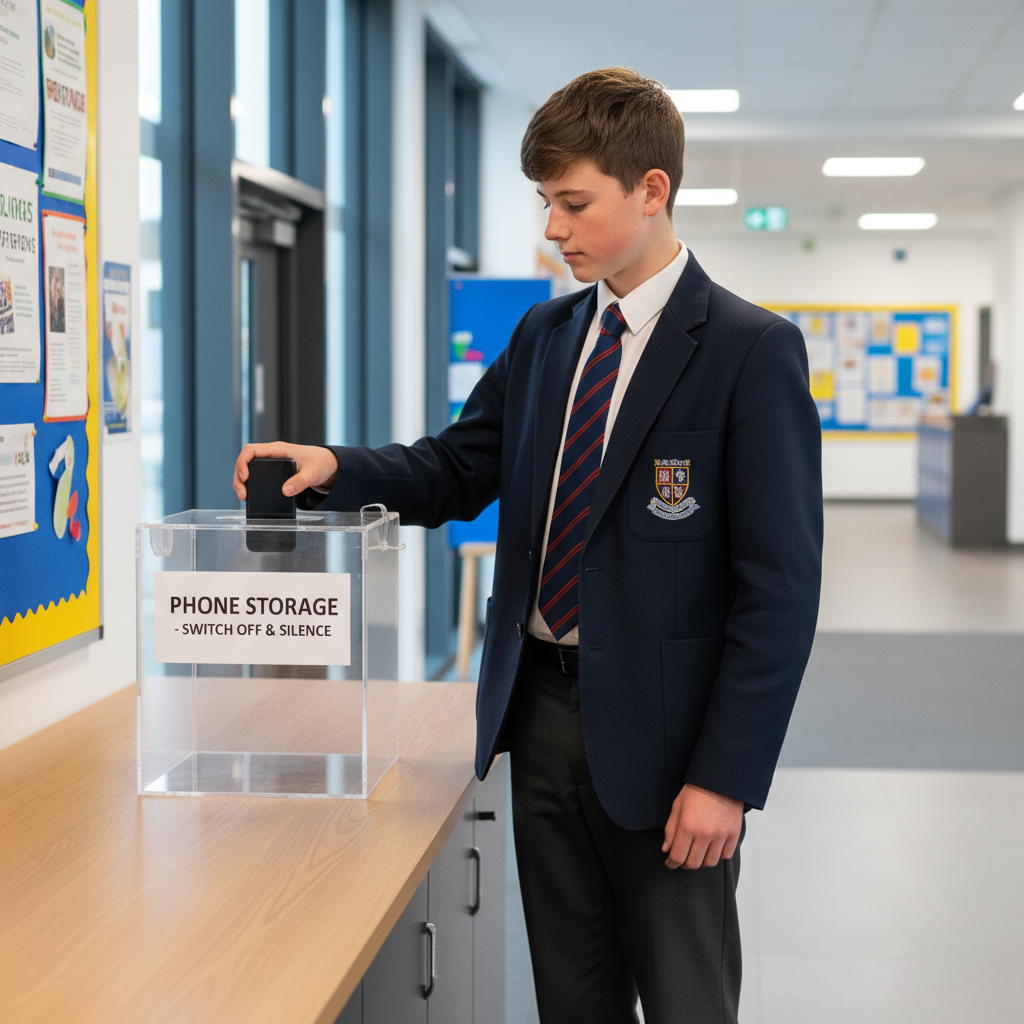
Your child will likely need to hand in their phone at the start of the school day. Schools may use locked pouches, collection boxes, or secure storage systems. Each school will determine its own method.
During School:
No phone access at all. Not for checking messages, not for music during lunch, not for taking photos with friends. The aim is a completely phone-free environment.
End of Day:
Phones returned at the end of the school day, typically at final bell or during form time.
Emergencies:
Schools will still have systems for parents to contact children urgently through the school office. This has always been the case, and phones were never necessary for genuine emergencies.
Different Approaches Schools Might Take
While the guidance is clear on the outcome (no phone use), schools have flexibility in how they achieve it:
Collection Systems:
Phones collected at registration and stored securely until home time. This is common in schools that have already implemented strict policies.
Locked Pouches:
Students keep phones in special pouches that lock at the start of the day and unlock at home time. The phone stays with the student but cannot be accessed.
Home Storage:
Some schools may simply tell students not to bring phones at all, keeping devices at home entirely.
Locker Storage:
Phones stored in student lockers and not accessed during the day.
Your child's school will communicate their specific approach, but the end result should be the same: no phone use during school hours.
What Parents Are Saying
Reactions from parents have been mixed, though many support the principle.
Common Concerns:
"How will I contact my child in an emergency?" School offices have always handled urgent contact. Nothing changes here. In a genuine emergency, schools will get messages to children immediately.
"My child walks home alone and needs a phone for safety." The ban applies during school hours. Children can have phones for their journey, stored away once they arrive and returned when they leave.
"What about using phones for homework apps?" Educational technology should be provided by schools during lessons. Homework requiring internet access can be done at home on any device.
Supportive Views:
Many parents welcome the clarity. Esther Ghey, whose daughter Brianna was killed by teenagers who had viewed violent content online, called the guidance "a step in the right direction" but argued for even stronger legal requirements to prevent a "postcode lottery" of enforcement.
How Teachers and Unions Have Responded
Generally Supportive, With Caveats:
Teaching unions have welcomed the overall direction but pushed back on using Ofsted as the enforcement mechanism.
Paul Whiteman, general secretary of the National Association of Head Teachers, said school leaders "need support from government, not the threat of heavy-handed inspection."
Pepe Di'Iasio from the Association of School and College Leaders said the letter provides clarity for schools and parents, and he hopes it will lead toward the broader social media ban for under-16s.
Concerns About Policing:
One union described using Ofsted to "police" phone policies as "deeply unhelpful and misguided." Teachers worry about the additional burden of enforcement and the potential for conflict with students and parents.
What About Other Parts of the UK?
This guidance only applies to England. Education is devolved, so Wales, Scotland, and Northern Ireland set their own policies.
Wales:
The Senedd said last year that phones should not be banned "outright" but that schools should set their own policies with government support.
Northern Ireland:
Education Minister Paul Givan has advised restrictions and recently supported a campaign encouraging parents not to buy smartphones for children until age 14.
Scotland:
Schools have been given guidance on setting their own rules, such as handing in phones before lessons or banning them on school trips.
If you live outside England, check with your child's school for their specific approach.
Preparing Your Child for the Change
If your child's school hasn't already implemented strict phone policies, here's how to prepare:
Have the Conversation:
Explain why the rules are changing. Focus on the benefits: better concentration, more face-to-face time with friends, less drama from social media during the day.
Practice Phone-Free Time:
If your child is used to constant phone access, start building in phone-free periods at home. This makes the transition easier.
Discuss Alternatives:
What will they do during breaks instead of scrolling? Encourage thinking about activities, conversations, and games that don't require devices.
Address Anxiety:
Some children feel genuine anxiety about being separated from their phones. Take this seriously but help them understand they'll adapt quickly, and most students report feeling better once they adjust.
Model Good Behaviour:
If you want your child to accept phone-free school time, consider your own phone habits. Are you constantly checking your device? Children notice.
Looking Ahead: The Social Media Consultation
The phone-free schools guidance is part of a bigger picture. The government is consulting on banning social media entirely for under-16s.
Key Points:
- Three-month consultation now underway
- Would apply across the whole UK
- Conservative leader Kemi Badenoch has said her party would support such a ban
- Teachers are being encouraged to contribute their professional insights
If a social media ban passes, the phone-free school policy becomes even more significant. Schools would be supporting a broader societal shift in how young people interact with technology.
Questions to Ask Your Child's School
As policies are implemented, consider asking:
- What is your specific phone storage system?
- What happens if a child is caught with a phone during the day?
- How will you communicate with parents about implementation?
- What support is available for children who struggle with the adjustment?
- How will emergency contact work?
- When exactly do phones need to be handed in and when are they returned?
Frequently Asked Questions
When do these rules come into effect? The guidance is effective immediately. Schools should already be implementing or strengthening their policies. Ofsted will begin inspecting on this basis.
Can my child bring a phone to school at all? Yes, for the journey to and from school. But it must be stored away and not used during school hours, including breaks.
What if my child has a medical condition that requires phone monitoring? Schools must make reasonable adjustments for medical needs. Discuss specific requirements with your school's SENCO or head of year.
Will teachers also be banned from phones? Teachers are advised not to use phones for personal reasons in front of pupils. Schools will set their own staff policies.
What about smartwatches? The guidance focuses on phones, but schools may extend policies to cover smartwatches with communication features. Check your school's specific rules.
Can my child use their phone for music during breaks? No. The guidance explicitly bans phone use during break times and lunchtimes, including for music.
---
Source: BBC News, Department for Education
This article was last updated on 28 January 2026. Information is accurate at time of publication but school policies may vary in implementation.