Summer-Born School Admissions: How to Delay Reception by a Year
Summer-born school admissions are the one part of the English system where the default and the law point in different directions. A child born on 30 August is offered a reception place the September after they turn four, at four years and a few days old. The law does not require them to be in school for another twelve months. Closing that gap is a request, not a right, and the way you make it decides whether it works.
Who this applies to
A summer-born child is one born between 1 April and 31 August. The distinction matters because compulsory school age in England begins in the term after a child's fifth birthday, and for this group that term falls a full academic year after the September they would normally start reception.
Children born in the autumn and spring reach compulsory school age during the reception year they are offered, so the question does not arise in the same way. For an August baby, the September place on the table is genuinely optional.
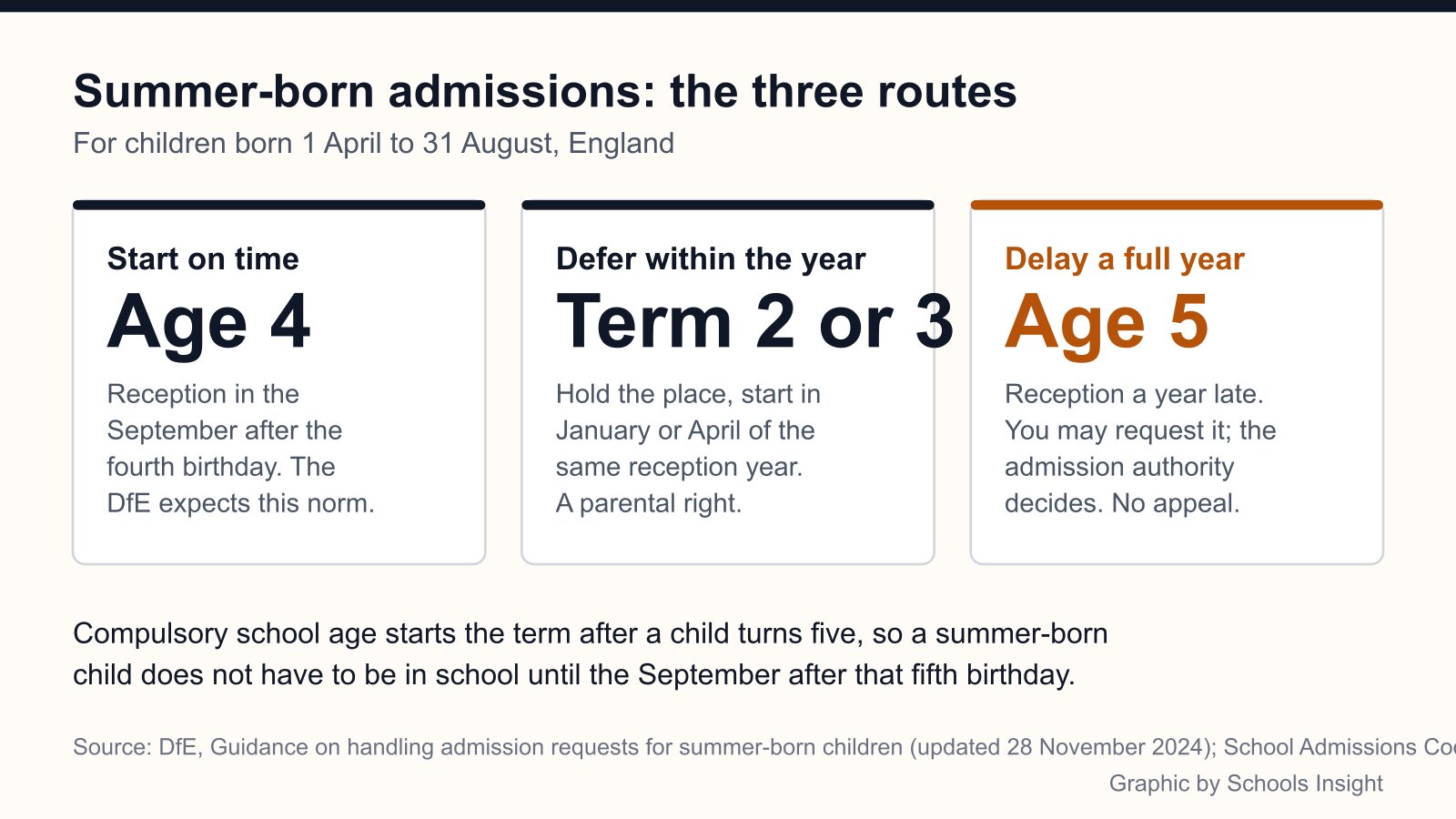
The three routes, plainly
1. Start reception at four, with the year group
The normal route, and the one the Department for Education expects. Its guidance for admission authorities states that it does not believe it should be the norm for summer-born children to start reception at five, and that most children will thrive if admitted at the usual time. Schools build reception around four-year-olds, including the summer-born ones.
2. Defer the start date within the same reception year
You can accept the place and start your child later in that same school year, in January or after Easter, up to the term in which they reach compulsory school age. This is a parental right rather than a request: the school must hold the place. The trade-off is that your child joins a class that has already formed its friendships and routines, and they cannot start later than the summer term.
3. Delay a full year, so they enter reception at five
This is the route people mean when they talk about deferring a summer-born child. You ask the admission authority to admit your child to reception outside their normal age group, a year behind. Paragraph 2.19 of the School Admissions Code requires the admission authority of each school to make that decision on the circumstances of the case and in the child's best interests, and the DfE guidance says it should be rare for an authority to refuse.
What the admission authority must take into account
The published guidance lists the factors. An authority considering a request must weigh:
- the parents' views, and their reasons;
- the child's academic, social and emotional development;
- any relevant medical history and the views of a medical professional;
- whether the child was born prematurely, and would have been an autumn birth at full term;
- the likely impact of missing a year of education, if the request were agreed and the child later had to skip a year.
Two things follow. First, the guidance is explicit that there do not need to be exceptional circumstances, and that a child does not need a medical need or SEND for out-of-year-group admission to be in their best interests. Second, because the decision belongs to each school's admission authority, two schools can reach different answers on the same child: a community school where the local authority is the admission authority, and a nearby academy or voluntary aided school which is its own.
The point that catches people out: parents whose request for delayed entry is refused have no statutory right to appeal that decision. Appeals exist for the refusal of a school place, not for the refusal of a year group. So the strength of the original request is the whole game.
How to make the request well
Ask early, in the autumn before the normal application round, and ask the admission authority of every school you intend to name, not just your first preference. Put it in writing and keep it to the factors above.
- State what you are asking for precisely. Admission to reception in September of the following year, outside the normal age group. Not "deferral", which also describes route two and causes confusion.
- Give child-specific evidence. A nursery key person's written observations on self-care, speech, stamina and separation carry more weight than general argument about summer birthdays.
- Include the medical view where there is one. Prematurity is worth spelling out with the due date, because a child born in August at 28 weeks would have been a November birth.
- Say what you will do with the extra year. Naming the nursery setting and hours shows the year is provision, not a gap.
- Ask for the decision and the reasons in writing. You need it before national offer day, and you need it before you turn any place down.
If you are working through the timetable at the same time, our guides to applying for a primary school place and the application deadlines set out the dates, and how to rank your preferences covers the part of the form that does the real work.
If the answer is no
Two options remain, and they are not equally good. You can accept the reception place your child was offered, and use route two to start them in January or after Easter. Or you can decline, and make an in-year application for year 1 in the September after their fifth birthday, which means skipping reception altogether. The second is the outcome the guidance points at when it lists the impact of missing a year of education, and in-year applications compete only for whatever places are actually vacant, so there is no guarantee of the school you wanted. Our page on in-year admissions explains how that route works in practice.
A refusal is also worth reading carefully. If the letter does not show that the authority considered the listed factors and the individual child, that is a procedural point you can raise with the authority, and with the Office of the Schools Adjudicator on the admission arrangements, even though the individual decision itself carries no appeal.
Once they are in
Agreement for reception at five is not automatically agreement for the rest of school. The child stays out of their normal age group, and a later move, most obviously the transfer to secondary, needs the same kind of request to the next admission authority. Ask, when the primary place is agreed, what the school's position will be at year 6. Our guide to the primary to secondary transition covers the mechanics of that transfer, and preparing your child for reception is worth a read whichever route you take.
Frequently Asked Questions
Who counts as a summer-born child for school admissions?
A child born between 1 April and 31 August. They reach compulsory school age in the term after their fifth birthday, which is a full year after the September they could first have started reception.
Do I have to send my summer-born child to school at four?
No. No child in England has to be in school until the term after they turn five. What you do have to decide is whether they join reception at four, join it later in the same year, or start reception a year later than their age group.
Can I insist on my child starting reception a year late?
No. You can request it, and the DfE guidance says it should be rare for an authority to refuse, but the decision belongs to the admission authority of each school you apply to. It must decide on the individual circumstances and in the child's best interests.
Is there a right of appeal if the request is refused?
No. Parents whose request for delayed reception entry is refused have no statutory right of appeal against that decision. You can appeal a refusal of a school place, which is a different thing, or make an in-year application for year 1 instead.
Does my child need a medical need or SEND for the request to succeed?
No. The DfE guidance is explicit that there do not need to be exceptional circumstances, and that a child does not need a medical need or SEND for out-of-year-group admission to be in their best interests.
What is the risk of turning down the reception place?
If you refuse a reception place and the delayed request is not agreed, your child would be applying for year 1 in the September after their fifth birthday, skipping reception entirely. That is the outcome the guidance warns against, so get the decision in writing before you decline anything.
Sources: DfE, Guidance on handling admission requests for summer-born children (updated 28 November 2024); School Admissions Code, paragraph 2.19.
Related reading: the complete admissions guide, oversubscription criteria and what to do on national offer day.