
School Oversubscription Criteria Explained: How School Places Are Actually Allocated (2026 Guide for Parents)
Almost every guide to school admissions tells you to check a school's oversubscription criteria, then moves on as if you already know what that means. This is the page that actually explains it. By the end you will understand exactly how a popular school decides which children get in, why the order you rank your preferences does not work the way most parents assume, and how to read a specific school's policy so you can judge your real chances before you apply.
The whole system rests on one idea: when a school cannot take everyone who wants in, it does not pick at random or first come, first served. It applies a published, ranked set of rules. Learn how those rules fit together once and the rest of admissions becomes far easier to navigate.
What "oversubscribed" actually means
A school is oversubscribed when more children apply for a year group than there are places in it. The number of places is set in advance and is called the Published Admission Number, or PAN. A primary school might have a PAN of 30 for Reception; a large secondary might have a PAN of 240 for Year 7.
The logic from there is simple. If fewer children apply than the PAN, everyone who applies is offered a place. If more children apply than the PAN, the school is oversubscribed, and the admission authority must rank every applicant against its published oversubscription criteria and offer places from the top of that ranked list down until the places run out. The child who sits one place below the cut-off is refused, even by a single position.
That is the key mental shift. Oversubscription criteria are not a wish list or a points score you can game. They are a sorting order applied to everyone at once.
The equal preference system: ranking does not work how you think
This is the part that catches parents out, so it is worth slowing down. England runs an equal preference system. When you list your preferred schools on the application form, usually three to six of them depending on your council, each school you name considers your child completely independently and on equal terms. The school does not see whether you put it first or fourth.
Here is what happens behind the scenes. Each of your named schools ranks your child against its own oversubscription criteria, exactly as if you had named it first. The local authority then looks at every school that would offer your child a place and gives you the one that sits highest on your preference list. You only ever receive one offer, and it is the best one your child qualified for.
Two consequences follow, and both matter:
- Ranking a school lower never improves your odds at that school. A school cannot tell that you "only" put it third, so it cannot hold that against you or do you a favour for it. Putting a realistic school lower as a tactic gains you nothing.
- You should always list schools in your genuine order of preference. The only thing your ranking decides is which of the qualifying offers you actually receive. List the school you most want first, even if it is a long shot, because naming it costs you nothing elsewhere on the form.
If you have just been through National Offer Day, which in 2026 fell on 2 March for secondary places and 16 April for primary places, this is why your offer is the school it is. The system worked down your list and handed you the highest preference that could take your child.
The typical order of oversubscription criteria
There is no single national list of criteria that every school must use. Each admission authority sets its own, as long as the criteria are clear, fair, objective and lawful. Even so, most schools in England follow a recognisable pattern. A typical order looks like this:
- Looked after and previously looked after children. This group comes first by law. It covers children in the care of a local authority and those who were previously looked after, including children adopted from care or who left care through a special guardianship or child arrangements order, and certain children who were in state care outside England.
- Children with an exceptional medical or social need for that particular school. This is a narrow category that usually requires supporting evidence from a doctor, social worker or other professional showing why this school specifically is needed.
- Siblings. Children who already have a brother or sister at the school at the time they would start. Schools define "sibling" in their own policy, so check whether half-siblings, step-siblings or children at a linked school count.
- Faith or feeder priority. Faith schools may prioritise children of a particular religion, usually with proof such as a clergy reference or attendance record. Some schools give priority to children from named feeder primary schools.
- Distance from home to school. Whatever places remain after the categories above are filled go to the children who live closest, measured from home to school.
Distance also does a second job. Within every category above it, it acts as the tie-breaker. So if a school fills up partway through its sibling category, the siblings who live nearest get the remaining places and those slightly further away are refused. This is why a school can be described as "siblings only this year" in a popular area: every place went before distance alone even came into play.
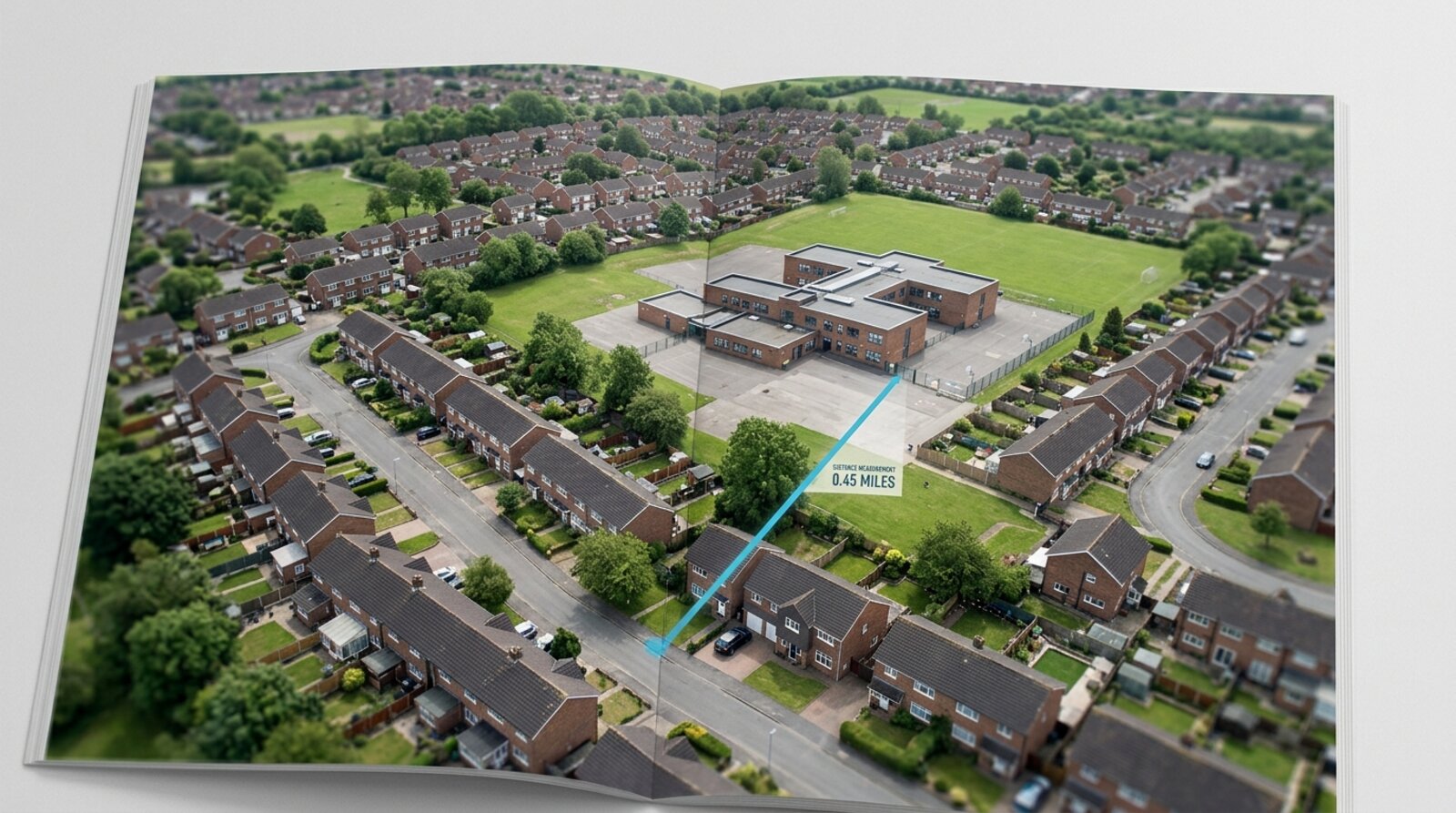
How distance is measured, and how ties are broken
Because distance decides so many places, how it is measured matters a great deal. Most admission authorities use a straight line, sometimes called "as the crow flies", from a fixed point at your home to a fixed point at the school, often the main gate or a central point, calculated by a mapping system. A minority measure the shortest safe walking route instead. The school's policy will state exactly which method it uses and what counts as your home address.
This has a practical edge. With straight-line measurement, a home that is closer on foot can still measure further than a neighbour's because a road bends or a footpath does not run in a straight line. Two houses on the same street can fall on opposite sides of the cut-off by a matter of metres. None of this is negotiable on the day; it is fixed by the published method.
Occasionally two or more children are an equal distance from the school, for example because they live in the same block of flats, and only one place is left. The policy must say how this is settled, and the answer is almost always random allocation. The place is drawn at random, usually by computer or an independent draw, so the outcome cannot be influenced. It is rare, but it is the genuine final tie-breaker in the system.
How to read a specific school's admissions policy
Every admission authority has to publish its determined admission arrangements each year, normally on the school's own website under "admissions" and on the local authority website. To work out your real chances at a named school, do this:
- Find the document for the correct year of entry. Arrangements change year to year, so make sure you are reading the policy for the September your child would start, not last year's.
- Read the oversubscription criteria in order. Note where siblings, faith and distance sit, and read the exact definition of each. The wording of "sibling" or "catchment" is where schools differ most.
- Check the PAN and recent intake. Many policies, and the local authority, publish how far down the criteria the school went in previous years, often as a "last distance offered" figure. If last year's places ran out within the sibling category, distance alone will not get a non-sibling in this year either.
- Confirm the distance method and the tie-breaker. Straight line or walking route, and random allocation for exact ties. This tells you whether your address is realistically in range.
Those published cut-off figures are exactly what our catchment and admissions tools turn into an estimate of your odds, so you are not reading raw numbers cold. Lists work the same way too: if your child is refused and joins a waiting list, that list is ranked by these same oversubscription criteria, not by how long you have waited, which is why your position can move up or down as families come and go.
What this means if you have just been refused
Understanding the mechanism changes how you respond to a "no". A refusal does not mean your child was unwanted or that anything went wrong. It usually means the school filled its PAN higher up the criteria than your child sat, often within siblings or close distance. Knowing that, your next moves are practical: accept the place you have been offered as a safety net, join the waiting list for the school you wanted, and consider an appeal if you have grounds. We set out the full sequence in our guide on what to do if you didn't get your first choice school after National Offer Day 2026.
For the official rules, the government's own page on school admission criteria sets out the broad categories, and the full School Admissions Code is the statutory document every admission authority in England must follow. You can also start your wider research from the Schools Insight homepage.
Frequently asked questions
What does oversubscribed mean for a school?
A school is oversubscribed when more children apply for places than there are places available in that year group. The number of places is the Published Admission Number, or PAN. When applications exceed the PAN, the admission authority uses the school's published oversubscription criteria to rank every applicant and decide who is offered a place.
Does the order I rank my preferences change whether I get a place?
No. England uses an equal preference system, so every school you name treats your application the same way whether you put it first, second or third. Each school ranks you against its own oversubscription criteria without seeing your order. You are then offered the highest preference on your form that can give you a place. Ranking a school lower never improves your odds there, so always list schools in your true order of preference.
What is the usual order of oversubscription criteria?
A common order is: looked after and previously looked after children first, then children with an exceptional medical or social need for that specific school, then siblings already at the school, then any faith or feeder-school priority, with home-to-school distance used last and as the tie-breaker within each category. There is no legal template, so the exact order and wording vary from school to school. Always read the named school's own admissions policy.
How is distance to school measured?
Most admission authorities measure a straight line from a fixed point at the child's home address to a fixed point at the school, often the nearest school gate, using a mapping system. Some use the shortest available walking route instead. The policy will say which method applies. Because the method is fixed, two homes the same distance from the door beyond a few metres can land on opposite sides of the cut-off.
What happens if two children are exactly the same distance from the school?
When two or more children qualify under the same criterion and are an equal distance from the school, for example living in the same block of flats, and only one place is left, the place is allocated at random. This is usually done by computer or by an independent draw, and the policy must state that a random tie-breaker is used.
Where do I find a school's oversubscription criteria?
Every admission authority must publish determined admission arrangements each year, normally on the school's own website under admissions and on the local authority website. Look for the document for the correct year of entry, find the oversubscription criteria section, and read the numbered list in order along with how distance is measured and how ties are broken.
Oversubscription criteria can feel impersonal, and in a sense they are meant to be: the point is that the same fixed rules apply to every family, with no room for who shouts loudest. Once you can read a school's policy and see where your child is likely to land, you stop guessing and start choosing schools on a clear-eyed view of your real chances.