Home › Guides › Health at school
School Flu Vaccine 2026: Who Gets It, the Consent Form, the Gelatine Question and Catching Up
The school flu vaccine is offered free every autumn to children in England from Reception to Year 11, and for the 2026 to 2027 season the arrangements are much the same as last year, with one addition: pharmacies will offer catch-up appointments from 1 December 2026. Most children get a quick nasal spray in each nostril during the school day, given by the local school immunisation team rather than by teachers. Parents are asked for consent beforehand, usually online. This page explains who is eligible, how the consent form works, the gelatine in the nasal spray and the injection alternative, which children should wait or have an injection instead, and what to do if your child misses the session.
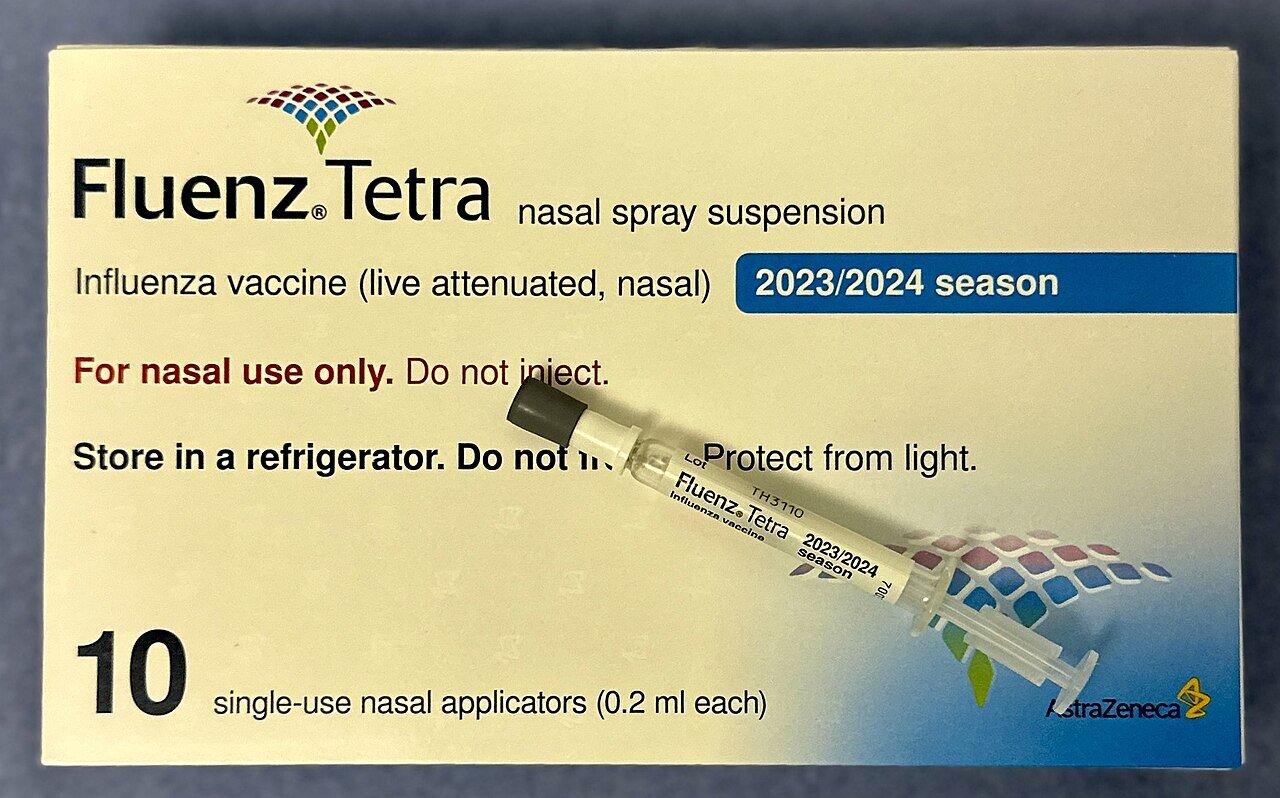
_with_box_2023.jpg)
Who: all school-aged children from Reception to Year 11, plus children aged 2 or 3 on 31 August 2026 (vaccinated at the GP or a pharmacy).
How: usually a nasal spray, one puff in each nostril, given at school in the autumn term.
Gelatine: the spray contains a small amount of pork gelatine; an injected vaccine without gelatine is available on request.
Missed it: community clinics run by the immunisation team, and some pharmacies from 1 December 2026. The last date for this season is 31 March 2027.
Who is offered the flu vaccine this year
According to the NHS children's flu vaccine page, the 2026 to 2027 programme covers:
- Children aged 2 or 3 on 31 August 2026. They are vaccinated at their GP surgery or at a pharmacy that offers free NHS children's flu vaccination, not at nursery.
- School-aged children, Reception to Year 11. They are normally vaccinated at school.
- Children aged 4 who are not yet in school, who can be vaccinated through the GP or community clinics.
- Children aged 6 months to 17 years with certain long-term health conditions, such as some heart, lung, kidney or neurological conditions. They are eligible whatever their school year, and the GP can vaccinate them, often earlier in the season.
Home-educated children of school age are eligible too. The local school immunisation team arranges clinics for them, and pharmacies can also vaccinate them from 1 December 2026.
How the school session works
The vaccine is given by the school age immunisation service, a team of nurses and healthcare staff who visit schools across the area. Schools host the session and pass on information, but school staff do not give the vaccine and do not decide who has it. Sessions run through the autumn term and into early winter, and each school is given a date by the team.
On the day, the nurse checks the consent record and asks a couple of quick health questions, then gives a puff of spray into each nostril. Your child does not need to sniff or breathe in. It takes a few seconds and children go straight back to class. Being vaccinated is not a reason to miss school, and a child can carry on as normal afterwards.
The consent form
A few weeks before the session, the school passes on a consent request from the immunisation team. In most areas this is an online form with a link sent by the school; some still use paper. It asks whether you agree to the vaccination, and about your child's health: asthma, allergies, recent flu vaccines, and anyone in the household with a severely weakened immune system.
- Fill it in even if the answer is no. A recorded refusal stops reminder messages, and the team knows not to vaccinate.
- Use the form to ask for the injection if you do not want the nasal spray because of the gelatine. Some forms have a tick box for this; otherwise use the comments or contact the team.
- Missed the deadline? Contact the immunisation team directly. Their details are on the letter or the consent link, and they can usually arrange a later clinic.
Older secondary school students who fully understand what is involved can sometimes give their own consent, under the same principles that apply to other medical treatment. In practice the team will normally want to hear from parents first.
The gelatine in the nasal spray, and the injection
The nasal spray contains a small amount of highly processed gelatine from pigs, which helps keep the vaccine stable. Some families, including many Muslim and Jewish families and vegetarians, prefer to avoid it. The NHS says an injected flu vaccine that does not contain gelatine is available. You can ask for it on the consent form or by contacting the immunisation team.
The nasal spray is offered first because it works well in children, is painless, and is easier to give to a whole school. The injection is a good alternative for families who do not want the spray, and it is the routine choice for children who cannot have the spray for medical reasons.
Children who should wait or have the injection
The NHS guidance gives several situations where the spray should be delayed or the injection used instead:
| Situation | What happens |
|---|---|
| High temperature | Wait until your child is feeling better |
| Very blocked or runny nose | The spray may be delayed until the nose clears, as it may not be absorbed well |
| Asthma flare-up in the past 72 hours, including wheezing or using a reliever inhaler more than usual | May need the injection instead |
| Asthma treated with long-term steroid tablets | Should not have the spray; injection offered |
| Severely weakened immune system, or living with someone who has one (for example after a bone marrow transplant) | Injected vaccine instead of the spray |
| Serious allergic reaction to a previous dose or an ingredient, such as gelatine | Should not have the spray; discuss with the team or GP |
Tell the team about any of these on the consent form, and again if something changes before the session. Some children with long-term health conditions who have never had a flu vaccine before need a second dose four weeks after the first.
Side effects
Side effects are usually mild and pass in a day or two. The most common after the nasal spray are a blocked or runny nose and a headache; some children feel tired or lose their appetite for a short time. After the injection the arm may be sore where the needle went in. Serious allergic reactions are very rare, and the staff giving vaccines are trained to deal with them.
A child who has had the nasal spray does not need to stay off school, and the vaccine cannot give them flu. If your child is unwell for another reason, our page on whether a child is too ill for school sets out the NHS stay-off times for common illnesses.
If your child misses the vaccine
Children miss the school session for all kinds of reasons: illness on the day, a late form, or a changed mind. There are three routes to catch up:
- Community clinics run by the school immunisation team, often on Saturdays or in school holidays. Contact the team to book.
- Pharmacies, from 1 December 2026, for school-aged children who missed the school vaccination or are home-educated. Not every pharmacy takes part, so check first.
- The GP, for children with long-term health conditions and for 2 and 3 year olds.
The last date to have this season's vaccine is 31 March 2027, but earlier is better, because the vaccine is meant to protect children before flu spreads most widely over the winter.
For more on health, attendance and school life, return to the Schools Insight home page.
Frequently Asked Questions
Which year groups get the school flu vaccine?
All school-aged children in England from Reception to Year 11. Children aged 2 or 3 on 31 August 2026 are vaccinated at the GP or a pharmacy instead.
Does the nasal flu spray contain pork gelatine?
Yes, it contains a small amount of gelatine from pigs. An injected flu vaccine without gelatine is available; ask for it on the consent form or contact the school immunisation team.
Can my child have the flu spray if they have asthma?
Usually yes. They should wait or have the injection if they have had a flare-up in the past 72 hours, and should not have the spray if their asthma is treated with long-term steroid tablets.
What if my child missed the flu vaccine at school?
Contact the school immunisation team for a community clinic. From 1 December 2026, some pharmacies can also vaccinate school-aged children who missed the school session. The season ends on 31 March 2027.
Do teachers give the flu vaccine?
No. It is given by the NHS school immunisation team. The school hosts the session and passes on consent requests.
Does my child need to stay off school after the flu vaccine?
No. Children go back to class straight away. Side effects such as a runny nose or headache are mild and usually pass within a day or two.
Source: NHS, Children's flu vaccine (2026 to 2027 season). Checked 6 October 2026.