Home › Guides
How to Complain About a School in England: the Procedure, the Panel and Who Comes After
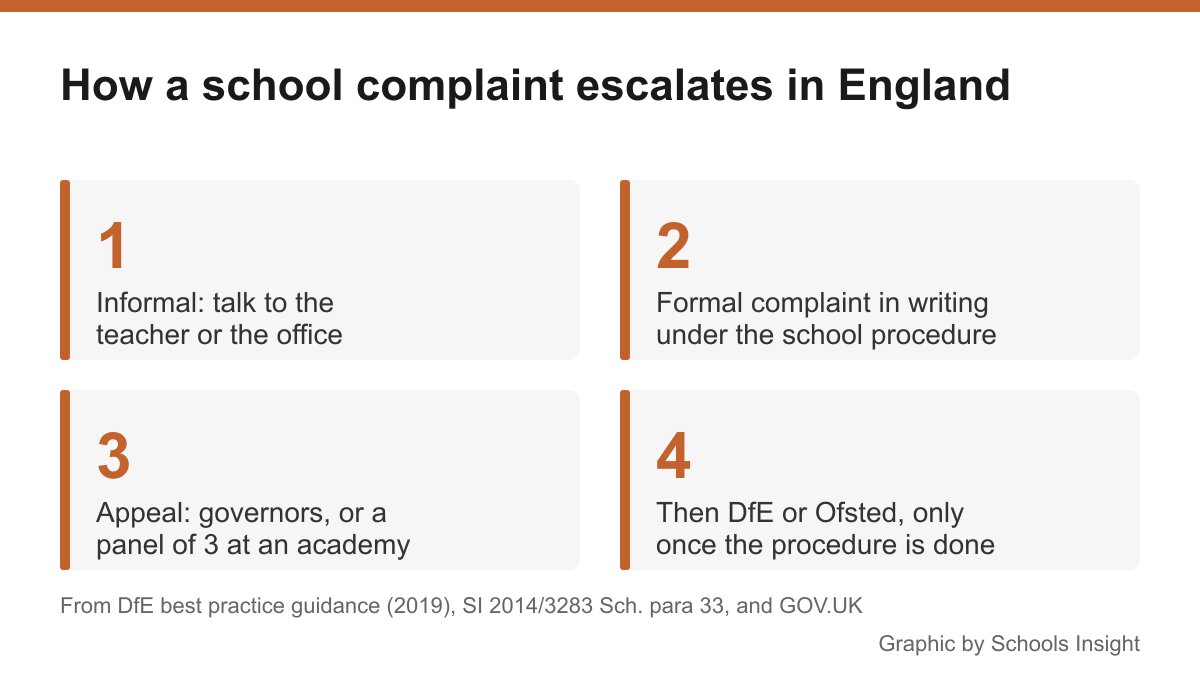
How to complain about a school comes down to one rule that decides almost everything: you have to use the school's own complaints procedure first, all the way to the end. The Department for Education and Ofsted will both turn a complaint away if you skip it, with only narrow exceptions. The good news is that every state school in England must have a procedure, and the law and DfE guidance say quite a lot about what it has to contain. Here is the route, stage by stage, and what each body above the school can and cannot do.
Before you start: is it a complaint the school handles?
Some problems have their own route and do not go through the school's complaints procedure at all:
| The problem | Where it goes |
|---|---|
| A child at risk of harm | 999 if in immediate danger; otherwise the local council or police on 101 |
| Criminal behaviour | The police |
| Refused a school place | An admission appeal, with its own deadlines |
| A permanent exclusion | The governing board's review, then an independent review panel |
| Special educational needs and EHC plans | The council, then the SEND Tribunal |
| Data protection | The Information Commissioner's Office |
| Exam malpractice (SATs) | The Standards and Testing Agency; for GCSEs and A levels, Ofqual and the awarding body |
We cover the main ones separately: admission appeals, exclusions and SEND tribunal appeals. Everything else, from bullying that has not been dealt with to poor communication, a decision you think is unfair or a teacher's conduct, starts with the school.
Stage 1: raise it informally
GOV.UK's advice is to contact the school and discuss the problem first, because most problems can be solved this way. An informal complaint is still a complaint: the school should tell you when it will respond and what the outcome is. Put it in an email even if you have also spoken to someone, so there is a date on it.
Timing matters. DfE's best practice guidance says it considers 3 months an acceptable time frame in which to lodge a complaint after an incident, with more time in exceptional circumstances. Schools can publish a cut-off, so do not sit on a problem for a term.
Stage 2: the formal complaint
If the informal route does not fix it, find the school's complaints procedure. Every school in England must have one; it is usually on the school website or available from the office. Read it before you write, because it will tell you who the formal complaint goes to (usually the headteacher, or the chair of governors if the complaint is about the head), what time limits apply at each step, and how to escalate.
A formal complaint works best when it is short and specific:
- What happened, with dates.
- What you have already done, and the school's response.
- Why that response does not resolve it.
- What you want to happen now: an apology, a change of practice, a meeting, a specific action for your child.
The last point is the one most people leave out, and it is the one that gives the school something to agree to.
Stage 3: the appeal to governors or a panel
This is where maintained schools and academies differ, and it is worth knowing which your child attends. Our types of school guide explains the difference.
Maintained schools
The governing body sets the procedure and, under section 29 of the Education Act 2002, must have regard to DfE guidance. That guidance recommends two stages, with the second an appeal heard by members of the governing body who consider the complaint afresh. Governors can bring in an independent investigator for the first stage, or co-opt governors from another school onto the panel, if the complaint is sensitive or the governing body is too close to it.
Academies and free schools
Academies must meet the Independent School Standards, which are more prescriptive. The procedure has to be in writing, set clear timescales, allow an informal stage and a formal written stage, and then provide a hearing before a panel of at least three people who were not directly involved. One panel member must be independent of the management and running of the school. You can attend and bring someone with you, and the panel's findings and recommendations must be sent to you.
One catch: GOV.UK notes you may not be able to complain to an academy or free school if you do not have a child there.
Stage 4: the Department for Education
Once you have completed the school's procedure and believe the complaint was not dealt with correctly, you can complain to DfE. You can go to DfE earlier only if a child is not getting an education, a child has been exposed to harm, or the school is stopping you from following its procedure.
Be clear about what DfE does. It looks at whether the school handled the complaint properly; it will not re-decide the original dispute. GOV.UK lists three things it cannot deal with: term-time holiday fines, a lack of compensation or apologies from the school, and the behaviour of school staff.
Ofsted: a different job
You can also complain to Ofsted once the school has not resolved the problem, but it is not an appeal. Ofsted considers complaints about things that affect the whole school rather than individual pupils. It records the complaint and may use it to decide what to focus on at the next inspection. It cannot resolve issues between you and the school, make the school respond, change the outcome of a complaint or change the school's procedure. A complaint to Ofsted does not mean the school will be inspected. If you want to understand what an inspection can find, see Ofsted reports explained.
Serious teacher misconduct
Behaviour that could lead to a teacher being barred, such as sexual misconduct or violence, can be reported to the Teaching Regulation Agency. GOV.UK asks you to follow the school's complaints process first and warns that a report may not be investigated unless you do. Anything involving risk to a child goes to the council or police straight away.
For free legal advice on schooling, GOV.UK points parents to Child Law Advice. The Schools Insight home page links our other guides for parents.
Frequently Asked Questions
How do I make a formal complaint about a school?
Find the school's complaints procedure on its website or from the office and follow its formal stage, usually a written complaint to the headteacher, or to the chair of governors if it concerns the head. Give dates, what you have already tried, why it is not resolved, and what you want the school to do.
Can I complain to the Department for Education about a school?
Yes, but normally only after you have completed the school's own procedure. The exceptions are when a child is not getting an education, has been exposed to harm, or the school is blocking you from using its procedure. DfE checks how the complaint was handled; it cannot deal with holiday fines, staff behaviour or demands for compensation.
Will Ofsted investigate my complaint about a school?
Not in the sense of resolving it. Ofsted considers complaints that affect the whole school, records them and may use them to plan the next inspection. It cannot settle a dispute between you and the school or change the outcome of a complaint.
How long do I have to complain about a school?
DfE's guidance treats 3 months after the incident as an acceptable time frame, with extra time in exceptional circumstances. Individual schools can publish a cut-off, so check the procedure and raise the matter promptly.
Who hears an academy complaint appeal?
A panel of at least three people who were not directly involved in the matter, one of whom must be independent of the management and running of the school. You can attend with a companion, and you must be sent the panel's findings and recommendations.
Can I complain about a teacher?
Yes, through the school's complaints procedure. For serious misconduct that could stop someone teaching, you can also report to the Teaching Regulation Agency, ideally after completing the school's process. If a child may be at risk, contact the council or police first.
Sources
- GOV.UK, complain about a school: other agencies, the DfE and Ofsted routes and their limits.
- DfE, best practice advice for school complaints procedures: two stages, the 3 month time frame and section 29.
- Education (Independent School Standards) Regulations 2014, Schedule Part 7: the academy complaints panel.