Home › Guides
Free School Transport: Who Qualifies in England, and How the Distances Are Measured
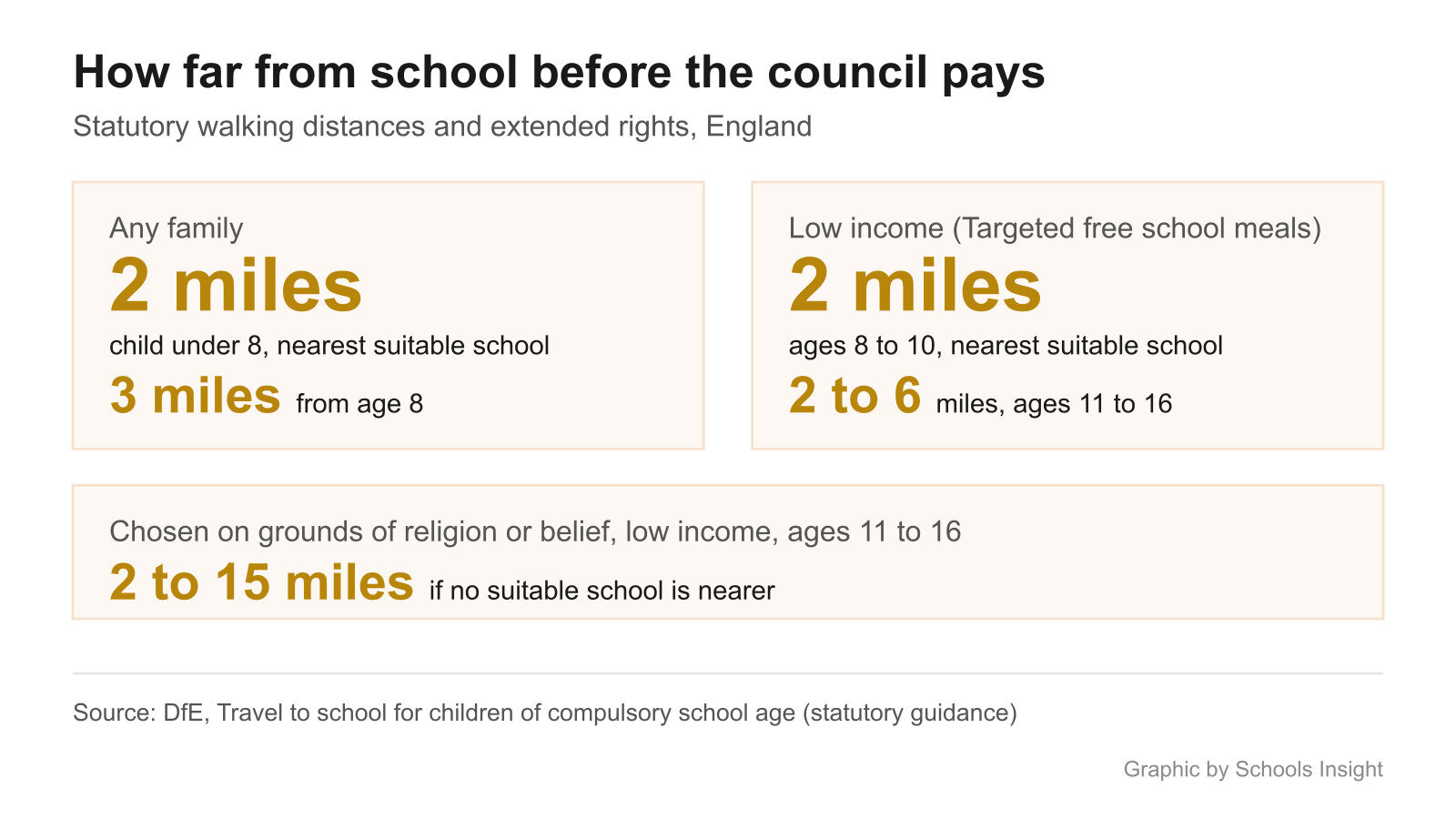
Free school transport is one of the few parts of the admissions system where the answer is a number rather than a judgement. If your child is under 8 and lives more than 2 miles from their nearest suitable school, the council must arrange free travel. From the age of 8 the line moves to 3 miles. Everything else in this area, including the arguments, comes down to how that distance is measured and which school counts as the nearest one.
The duty, in one paragraph
Under section 508B and Schedule 35B of the Education Act 1996, a local authority in England must make travel arrangements, free of charge, for every "eligible child" of compulsory school age in its area. Eligibility is not discretionary and it is not means tested unless you are relying on extended rights. If a child falls into one of the categories below, the council has to arrange travel and cannot charge for it.
The five routes to eligibility
1. Distance
A child under 8 is eligible for free travel to their nearest suitable school if it is more than 2 miles from home. A child aged 8 or over is eligible if it is more than 3 miles. Two worked examples from the Department for Education's own guidance show how tight the line is: a six-year-old at their nearest suitable school 2.3 miles away is eligible, while an eleven-year-old at their nearest suitable school 2.6 miles away is not.
2. Special educational needs, a disability or mobility problems
A child is eligible even inside the statutory walking distance if they attend their nearest suitable school and cannot reasonably be expected to walk there because of their special educational needs, a disability or mobility problems. This is assessed on the child, not the route.
3. An unsafe walking route
A child is eligible inside the distance if the nature of the route means they could not walk it in reasonable safety even accompanied by a parent, and there is no safe alternative route within the distance. Councils are told to assess the whole route, including footpath and bridleway sections, and to weigh risks such as canals, rivers, ditches, traffic speed and sightlines. Some use the Road Safety GB "Assessment of Walked Routes to Schools Guidelines" as a starting point, though the guidance says these are not a complete assessment on their own.
4. Extended rights, for low-income families
This is the part most parents have never heard of. From the start of the 2026/27 academic year, benefits-based free school meals split into two categories: Targeted FSM, for households on Universal Credit with annual earnings of no more than £7,400, and Expanded FSM, for other households on Universal Credit. Extended rights to free travel continue to apply to Targeted FSM only.
Where a child qualifies on that basis, the distances change:
- Aged 8 or over but under 11, attending their nearest suitable school, more than 2 miles from home.
- Aged 11 to 16, attending one of their three nearest suitable schools, more than 2 miles but not more than 6 miles from home.
- Aged 11 to 16, attending a school between 2 and 15 miles from home chosen on grounds of religion or belief, where there is no suitable school nearer.
The three nearest schools rule is worth reading twice. A child eligible for Targeted FSM whose nearest three suitable schools are 2.5, 3 and 5 miles away is entitled to free travel to any of them. A child whose nearest is 1.5 miles, second 2.2 miles and third 5.5 miles gets travel to the second and third, but not the nearest, because it falls inside the 2 mile floor.
5. Transitional protection
Where a child qualified for and was receiving extended rights travel on 31 March 2025 and still meets the criteria, the Department expects councils to keep providing free travel until the end of that phase of education or until they leave the school, whichever comes first. If your council has withdrawn a pass from a child in that position, this is the paragraph to quote.
How the measuring actually works
This is where most disputes start. For the statutory walking distances, the council must measure the shortest route along which a child, accompanied as necessary, may walk in reasonable safety. It is explicitly not the shortest distance by road, and it may include footpaths, bridleways, other pathways and alternative entrances to the school. A route through a park that you would never send a nine-year-old down alone can still count, because the test allows for the child being accompanied.
For extended rights, the measuring is mixed. Whether a child lives more than 2 miles from a school is measured the same walking way. But whether they fall inside the 6 mile or 15 mile upper limits is measured by road routes only, because nobody expects a child to walk 15 miles.
If you think the council has measured wrong, ask in writing which route it used and whether it was assessed on foot or by software. The guidance itself says that while technology is valuable, it may sometimes be appropriate for a route to be walked at the times and on the days the child would travel, particularly where safety is challenged.
Which school counts as the nearest
Eligibility on distance depends on attending the nearest suitable school, and both words do work. A school that is oversubscribed and cannot offer your child a place is not one they could have attended. Where two schools are a very similar distance away and both are within walking distance, the council should decide by the shortest walking route; where both are beyond walking distance, it may use the shortest road route or a straight line, and it has to say which method it uses in its published school travel policy.
This interacts directly with how you ranked your preferences. If you are still at the application stage, read our guide to ranking school preferences and the explanation of how catchment areas work before you submit, because a choice made for good reasons in October can cost a bus pass the following September.
If you are turned down
Every council runs a two-stage review of travel decisions. Stage one is a review by a senior officer; stage two is a review by an independent appeal panel. The timescales are set out in the statutory guidance and your council must publish them. Two practical points: put the specific eligibility ground you are relying on in writing at stage one rather than a general complaint, and attach evidence for it, whether that is a Targeted FSM confirmation, an EHC plan, photographs of the route, or a letter showing the nearest school refused a place.
Our guide to school admissions in England sets out the wider timetable, and free school meals and Universal Credit in 2026 explains the Targeted and Expanded categories that extended rights now hang on. The Schools Insight home page links the rest.
Frequently Asked Questions
How far do you have to live from school to get free transport?
More than 2 miles if your child is under 8, and more than 3 miles from the age of 8, provided they are attending their nearest suitable school. Those are the statutory walking distances set by section 444(5) of the Education Act 1996. Living one step inside the line means the council has no duty, however awkward the journey is.
How is the distance to school measured?
By the shortest route along which a child, accompanied as necessary, could walk in reasonable safety. That is not the same as the shortest route by road: it can run along footpaths, bridleways and alternative school entrances, which is why a council's figure is often shorter than a satnav's. For the 6 and 15 mile upper limits under extended rights, councils measure road routes only.
What are extended rights to free school travel?
A more generous set of distances for children from low-income households, defined by eligibility for Targeted free school meals. Children aged 8 to 10 qualify beyond 2 miles to their nearest suitable school. Children aged 11 to 16 qualify for any of their three nearest suitable schools between 2 and 6 miles, or up to 15 miles for a school chosen on grounds of religion or belief where nothing suitable is nearer.
Can I get free transport if my child did not get into the nearest school?
Usually yes. The duty attaches to the nearest suitable school, and the guidance is clear that a school which is oversubscribed and unable to offer a place is not available to that child. If your child was refused at the nearest school and had to take a place further away, say so in the application rather than assuming the distance rule shuts you out.
What if the walking route is dangerous?
There is a separate ground for that. A child qualifies even inside the statutory walking distance if the nature of the route means they could not walk it in reasonable safety, even accompanied by a parent, and there is no safe alternative within the distance. Councils must look at the whole route, including canals, rivers, ditches, traffic speeds and sightlines, not just the road sections.
Is free school transport available after 16?
Not under this duty. The statutory travel duty in this guidance covers children of compulsory school age, 5 to 16. Post-16 travel is a separate and much weaker duty, and most councils charge for a sixth form or college pass. Check your council's post-16 transport policy statement, which they must publish each year.
Sources
- Department for Education, Travel to school for children of compulsory school age: the statutory walking distances, the eligibility categories, extended rights and how routes are measured.
- Education Act 1996, section 444: subsection (5) prescribes the statutory walking distances.