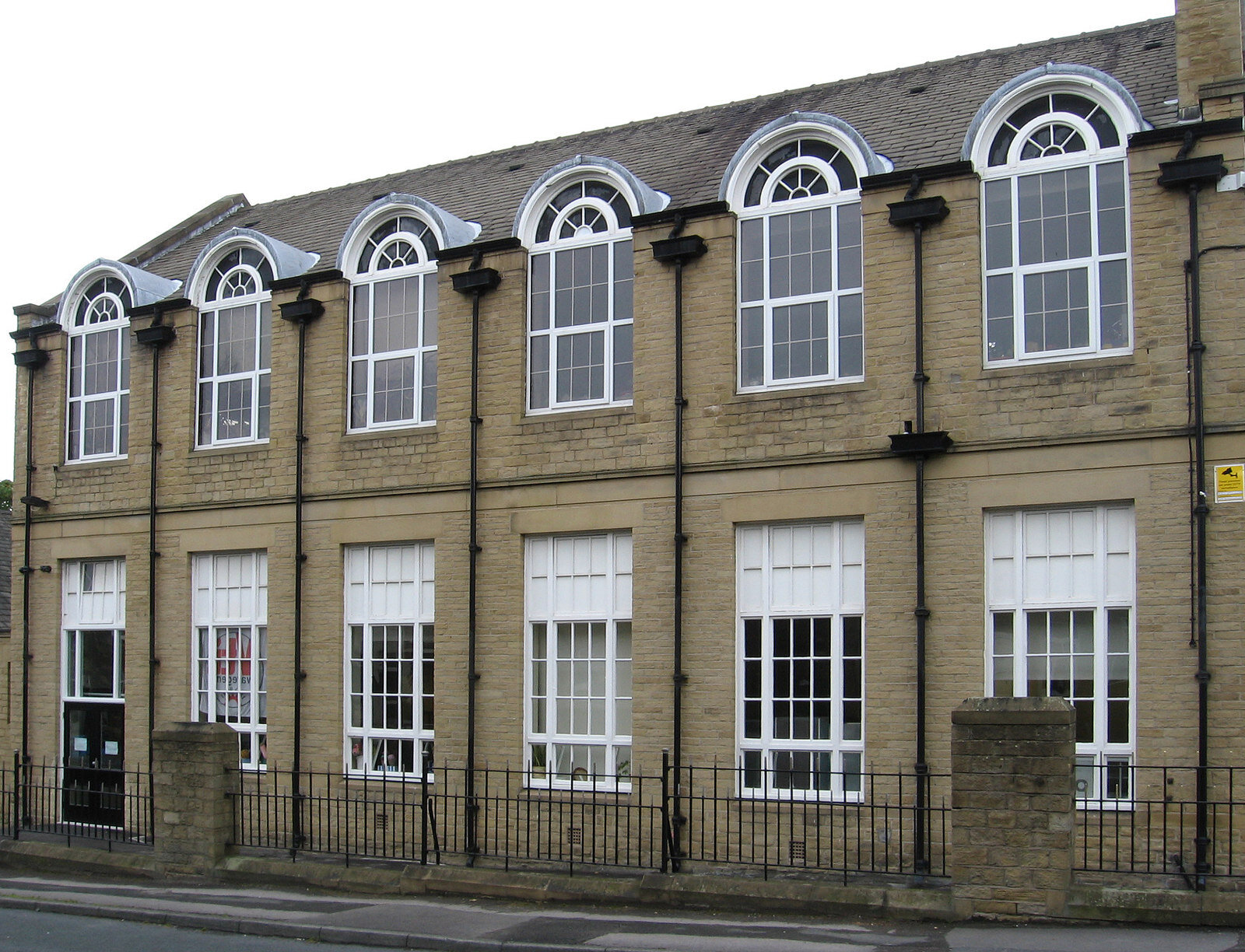
Heckmondwike - Grammar School building by Dave Bevis (CC BY-SA 2.0), via Geograph and Wikimedia Commons.
11-Plus Subjects Explained: Verbal, Non-Verbal, Maths and English
The 11-plus subjects come down to four skills: English, maths, verbal reasoning and non-verbal reasoning. What confuses parents is that these are rarely four separate papers. Most selective areas bundle them into two, mixing a reasoning section with a curriculum subject in each, and the mix differs from county to county. Knowing which four things are being tested is the easy part; knowing how your area packages them is what actually shapes the preparation.
This guide sets out what sits inside each of the four, how a real county assembles them into papers, what a standardised score is, and where the preparation time is best spent.
What one real test looks like
Buckinghamshire publishes its arrangements clearly, so it is a useful concrete example. The Secondary Transfer Test there is two papers, all multiple choice. One tests verbal skills, meaning comprehension, technical English and verbal reasoning. The other tests mathematics and non-verbal skills, including spatial reasoning. Each paper takes about 45 minutes of working time, or 60 minutes including the introduction and worked examples.
The two standardised scores are added to give a combined Secondary Transfer Test Score. A score of 121 or above qualifies for grammar school, and the council expects around 37 per cent of children to reach it. Notably, scoring well above 121 gives no extra priority, because Buckinghamshire grammar schools do not use the score as an admission rule.
Your area will differ in the detail, sometimes considerably. But the shape, two papers, four skills, roughly two hours, is common.
English
The English element is usually comprehension plus what test setters call technical English: spelling, punctuation, grammar and vocabulary. A passage is followed by questions on what it says, what it implies, what a word means in context, and how it is written. The passages are frequently older or more literary than a Year 6 reading book, which is the point.
A minority of areas also set a separate writing task, marked for content and technical accuracy, sometimes used only for borderline candidates rather than scored for everyone. If your area does this, find out early, because it needs a different kind of practice from anything multiple choice.
The single highest-return thing here is reading volume and range. Vocabulary is the common thread running through English comprehension and verbal reasoning, and it cannot be crammed in a term.
Maths
Maths follows the Key Stage 2 curriculum, but usually at a faster pace and with more multi-step word problems than school tests use. Expect arithmetic and number, fractions, decimals and percentages, ratio and proportion, measures and unit conversion, geometry and angles, area and perimeter, simple algebra, and data handling from tables and graphs.
Two things separate 11-plus maths from classroom maths. Speed: there is no time to work every question long-hand, so mental arithmetic fluency does real work. And question wrapping: the mathematics is often Year 5 level, but buried in two or three sentences of context that must be unpicked first. Children who are strong at maths but slow readers lose marks here for reading reasons, not mathematical ones.
Verbal reasoning
Verbal reasoning is language puzzles, not comprehension. The recurring question types are letter and number codes, word analogies, odd one out, hidden words spanning two words in a sentence, compound words, missing letters, alphabet sequences and simple logic problems.
It is the section that has least to do with ordinary school work, which is why it feels the most alien and why familiarisation matters so much. There are perhaps twenty standard question types, each with a method; a child who recognises the type instantly is enormously faster than one working it out from scratch. Underneath the puzzles, vocabulary is the limiting factor again.
Non-verbal reasoning
Non-verbal reasoning uses shapes instead of words: sequences, rotations, reflections, matrices, analogies and odd one out, all expressed as figures. Many tests, Buckinghamshire's among them, add spatial reasoning, which brings in three-dimensional questions such as cube nets, folded and unfolded shapes and views from different angles.
Because no reading is involved, this section often flatters children whose English is still developing, including those who speak another language at home. It is also the section where practice produces the fastest visible improvement, because most of the difficulty is unfamiliarity rather than ability.
Standardised scores, and why the raw mark is not the point
Almost every selective area standardises scores. That means the raw mark is adjusted for the child's age in months when they sat the test, so that a September-born child is not advantaged over a child born the following August. Buckinghamshire then weights the standardised scores according to the verbal, mathematical and non-verbal sections before combining them.
Two consequences follow. A raw mark out of the total tells you very little on its own. And the weighting means that in some areas a weak section can be partly offset elsewhere, while in others it cannot. Our guide to 11-plus pass marks goes through how different areas set and apply their thresholds.
Who writes the papers, and why old advice may not apply
Most selective areas now use papers from GL Assessment. CEM, the other long-standing provider, stopped supplying standard 11-plus papers after 2022, so a good deal of the guidance still online, built around choosing between GL-style and CEM-style preparation, is out of date. A number of super-selective schools and consortia commission their own papers instead.
The practical rule is simple: do not prepare for a format you read about, prepare for the one your target schools publish. Every selective area sets out its arrangements, and the schools themselves publish familiarisation material. Read that before buying a single practice book.
Where to spend the preparation time
- Vocabulary and reading, from early. It carries English and verbal reasoning at once, and it is the only element that genuinely cannot be rushed.
- Question-type familiarity in the reasoning sections. The fastest gains, because recognition replaces working out.
- Timed practice. With papers this short, working accurately at pace is a separate skill from knowing the material.
- Mental arithmetic fluency. It buys the time needed for the multi-step problems later in the maths section.
For when to start and how to structure it, see how to prepare for the 11-plus. For how the whole selective system fits together, start with grammar school admissions in England, or browse everything from the Schools Insight homepage.
Frequently asked questions
What subjects are on the 11-plus?
Four skills, in almost every selective area: English, maths, verbal reasoning and non-verbal reasoning. They are rarely four separate papers. Buckinghamshire, for example, uses two papers, one testing comprehension, technical English and verbal reasoning, the other testing maths and non-verbal skills including spatial reasoning.
How long is the 11-plus test?
Shorter than most parents expect. In Buckinghamshire each of the two papers takes about 45 minutes of working time, or 60 minutes including the introduction and worked examples. That is the whole test in roughly two hours, which is why pace under time pressure matters as much as knowledge.
What is verbal reasoning in the 11-plus?
Language puzzles rather than English comprehension. Typical question types are letter and number codes, word analogies, odd one out, hidden words inside sentences, compound words, missing letters and sequences. It rewards a wide vocabulary and pattern spotting, and it is the section least covered by ordinary school work.
What is non-verbal reasoning?
Pattern recognition using shapes rather than words: sequences, rotations, reflections, matrices, odd one out and analogies made from figures. Many tests also include spatial reasoning, which adds three-dimensional questions such as cube nets and folded shapes. No reading is involved, so it is often where children with weaker English do relatively well.
What score do you need to pass the 11-plus?
It varies by area, and the number itself is meaningless without the local rule. Buckinghamshire uses a qualifying score of 121 on its combined standardised Secondary Transfer Test Score, and the council expects around 37 per cent of children to reach it. Other areas set different thresholds or rank candidates instead.
Is the 11-plus multiple choice?
Usually, but not always. Buckinghamshire's papers are entirely multiple choice. Some areas use standard-format answer papers where the child writes the answer, and a minority add a separate creative writing or extended English task. Check the arrangements published by the schools you are actually applying to, because this is the detail that changes most between areas.
Sources
- Buckinghamshire Council, the Secondary Transfer Test, paper structure and timings: buckinghamshire.gov.uk
- Buckinghamshire Council, marking the Secondary Transfer Test, standardisation and the 121 qualifying score: buckinghamshire.gov.uk
Arrangements checked on 24 August 2026. Test formats vary by area and change; always check the schools you are applying to.